The 90-Second Window: How to Turn a Fuel Stop into a Bigger Basket, from Forecourt to Counter

Ben Smith
An authority on digital transformation of physical spaces, Ben has 20+ years helping top-tier companies improve their customer and staff experience.
Fuel gets the customer onto the forecourt, but the next minute and a half determines whether the visit earns anything beyond a fuel margin. That window matters more than ever for Australian convenience retailers: the AACS 2026 Mid-Year State of Industry Report recorded in-store sales down 0.6% in value for the half, with 13 of 15 major categories selling fewer units. The association’s conclusion was direct: the channel’s next phase of growth depends on generating more customer visits and larger purchases.
Food is carrying that growth. Convenience foodservice has grown for eight consecutive years, rising 6.6% last year to $1.48 billion and now accounting for around 15% of total channel sales. Theo Foukkare, CEO of the Australian Association of Convenience Stores (AACS), frames the opportunity simply: consumers “fuel their car once a week, but they fuel their body three or four times a day.”
Conversion, however, has barely moved. In ACAPMA’s 2026 National Monitor of Fuel Consumer Attitudes, 22% of Australians said they generally buy other items when they refuel or charge, up from 20% in 2024 but still within the 18% to 22% band recorded in every edition since 2017. Foodservice growth shows the offer works for customers who come inside; the flat conversion rate shows it still fails to reach the four in five who do not.
Purchase behaviour sharpens the opportunity: only 18% of purchases are planned, down from 28% in 2024. Most baskets are therefore shaped on site, through a short and repeatable sequence of decisions between the pump and payment. We call this the 90-second window.
In brief
The 90-second window runs from the moment a customer finishes at the pump to the moment they pay. Across that journey, they make four connected decisions: whether to enter the store, what to buy, whether to add another item and whether the checkout experience is fast enough to complete the purchase. Retailers win the window by giving every screen one clear job, matching its message to the moment and managing the sequence consistently across the network.
22%
buy more than fuel when they refuel
79%
say price is what stops them
18%
of purchases are planned
$1.48B
convenience foodservice sales, up 6.6%
The basket is decided across four moments: the forecourt, the walk in, the counter and the checkout.
What is the 90-second window?
The 90-second window describes the sequence of decisions a customer makes between the pump and the payment. It spans four moments: the forecourt, where they decide whether to come inside; the walk in, where they decide what to buy; the counter, where they decide whether to add to the basket; and the checkout, where a slow queue can reverse all three.
The figure is a planning lens rather than a stopwatch reading. Some customers are in and out in under a minute, while others linger at the coffee machine. What makes the window useful is its consistency: the same decisions occur in the same order on almost every visit, at almost every site. Few retail journeys are this predictable, and that predictability is what makes it designable. Time on site also matters. ACAPMA’s 2026 data shows EV drivers, who stay while they charge, are almost twice as likely as average to buy something (42% versus 22%).
Why do so few fuel customers buy more than fuel?
Price perception is the dominant barrier, and it is hardening. In the ACAPMA 2026 Monitor, conducted in the wake of this year’s fuel price shock, a record 79% of fuel-only customers said in-store prices stop them buying more. Two other barriers also rose sharply: limited product range (25%, up from 19%) and poor product quality (14%, up from 6%). Together, the figures show that the problem is not only whether customers can afford an item, but whether they see enough value and choice to justify coming inside. Pay-at-pump and app payments compound that challenge by removing the one reason some customers had to enter the store.
The encouraging part is that perceived value is something a retailer can influence. An item judged on its shelf price alone gets compared, consciously or not, with the supermarket. The same item presented as part of a coffee-and-pastry bundle, a meal deal or a loyalty reward is judged on what the customer gets for their money. Shifting that frame early enough in the visit to shape the purchase is the central task of the 90-second window.
How to win the 90-second window, moment by moment
Each moment asks something different of the customer, so each calls for a different type of screen and a different kind of message. Treating them as one connected sequence, rather than four separate signage projects, is what makes the window work.
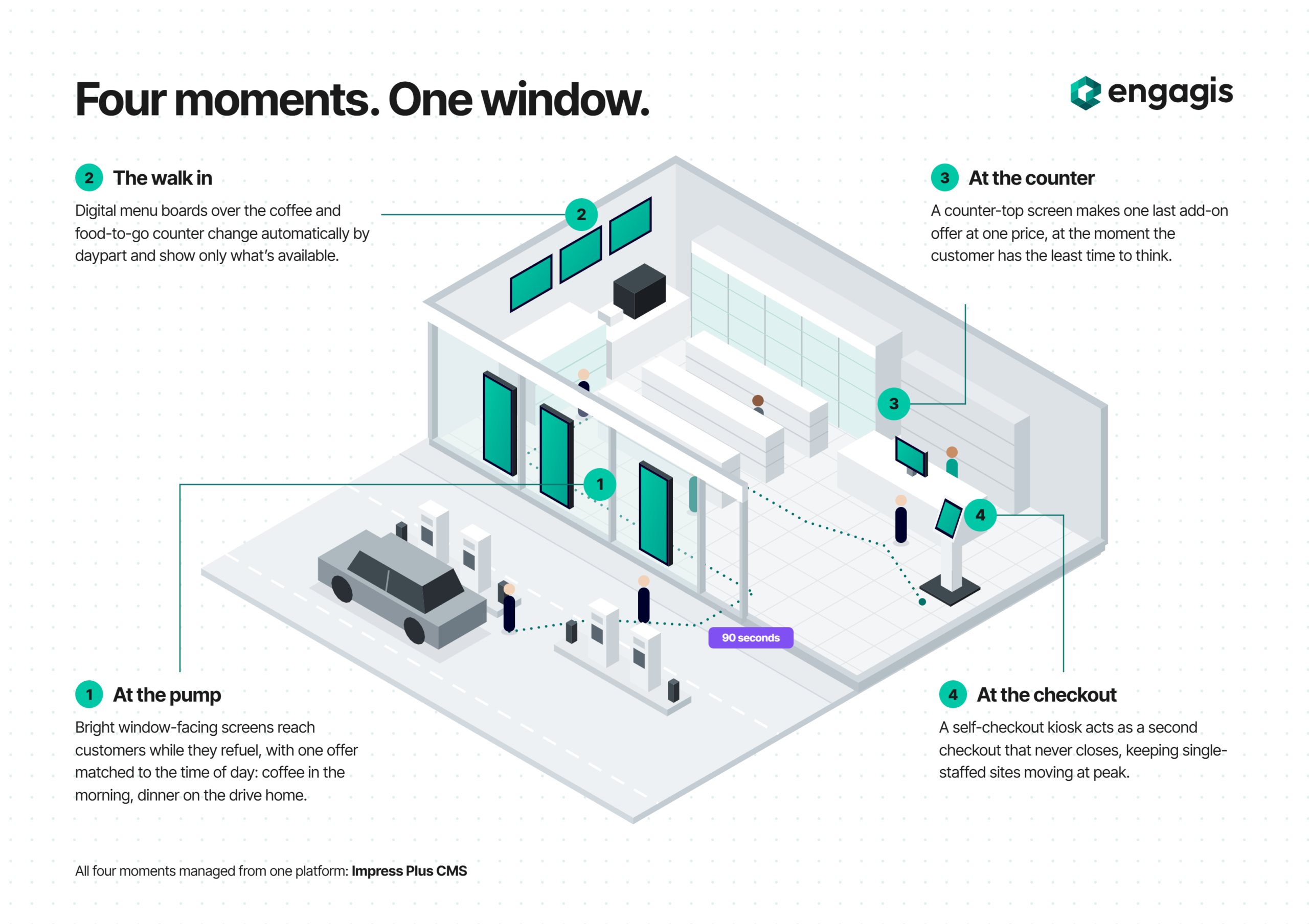
1. At the pump: give customers a reason to come inside
The first decision is made before the customer leaves the forecourt. High-brightness, window-facing displays reach customers while they refuel, putting a coffee, a meal deal or tonight’s dinner on their list before they reach the door. For pay-at-pump customers, these screens are often the only invitation to come inside.
The discipline here is restraint: one offer per screen, legible from the pump island and matched to the daypart. Breakfast coffee leads in the morning, lunch deals at midday and dinner solutions on the drive home. Forecourt-facing screens also need commercial-grade, high-brightness panels to stay readable in direct Australian sun, where a standard display quickly washes out.
2. The walk in: confirm the choice and show what’s fresh
Once inside, customers orient quickly: they look for what they came for and assess whether it’s worth the price. Digital menu boards for convenience stores and fuel station cafés do the heavy lifting at this stage. They change automatically from breakfast to lunch to late night, show only what’s available and let pricing be updated across the network in minutes, with no reprinting. With Impress Plus, Engagis’ Australian owned and hosted CMS, head office schedules each board by daypart once and every site follows, while store teams can update what’s available locally within the permissions head office sets.
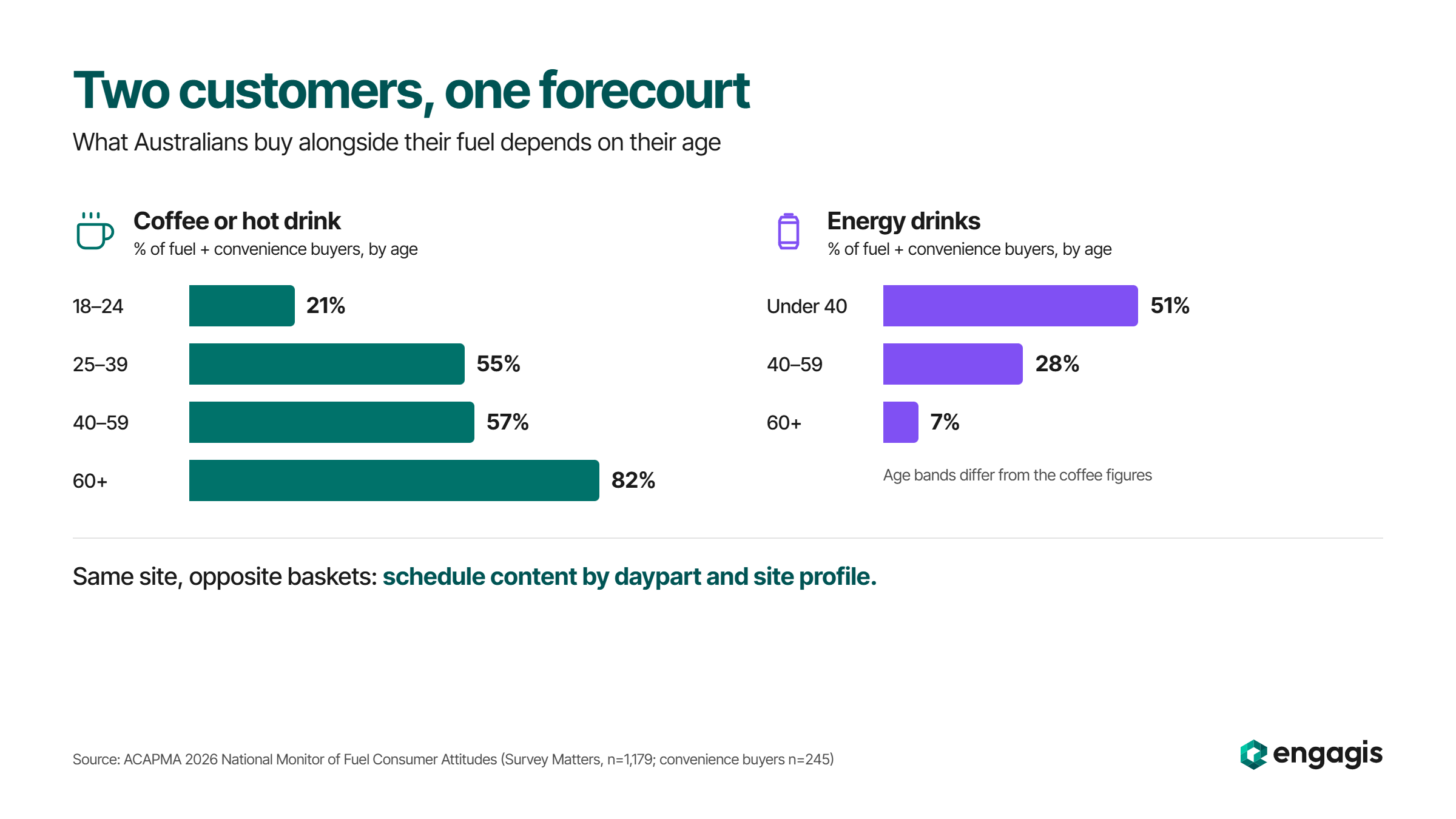
This is also where the core categories sit. Among customers who buy alongside fuel, cold drinks lead (64%), followed by chips, lollies and snacks (56%) and coffee (55%), according to ACAPMA. The more useful finding is how sharply the mix divides by age. Just 21% of 18–24-year-olds buy a hot drink with their fuel, against 82% of those aged 60 and over, while energy drinks run the other way: 51% of under-40s buy them, against 7% of over-60s. That’s a strong case for content that changes by daypart and site profile, leading with coffee for an older breakfast crowd, for example, and with cold drinks and energy drinks when a younger crowd comes through.
3. At the counter: win the last moment before payment
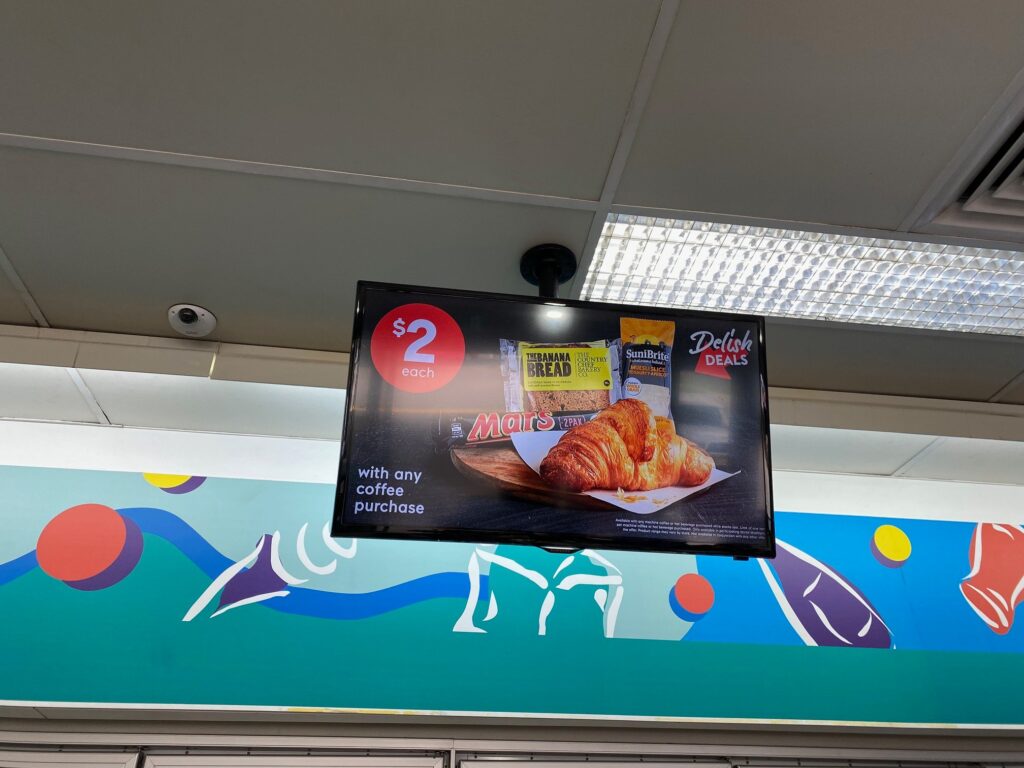
The counter is the final opportunity to grow the basket, and it is where the customer’s attention is shortest. Counter-top digital displays work best when they present one prompt at one price: a cold drink on a hot afternoon, a chocolate bar with coffee or a two-for-one snack deal. Anything that requires more than a few seconds of thought is wasted. The commercial stakes are rising: average convenience spend increased from $14.60 to $18.90 between 2024 and 2026, yet only 32% of buyers say they are spending more than a year ago. ACAPMA interprets that pattern as smaller baskets at higher prices, making the single add-on at the counter an important way to win back lost volume.
4. At the checkout: keep the queue moving when one person is on shift
Many convenience stores trade with a single team member for long stretches of the day. When a queue forms at peak, that person can’t serve customers and prepare food at once, and customers at the back of the line may drop the extra item or abandon the visit. That’s a costly failure, because time is much of what convenience customers pay for: 47% say they’d pay a little more for convenience, largely because it saves them time. With labour costs rising at around three times the rate of inflation, according to the AACS, rostering a second person to cover a few busy hours is increasingly difficult to justify.
Self-checkout kiosks for convenience stores provide a second checkout that can remain available throughout trade. Customers scan, pay and leave while the team member on shift prepares and merchandises food. Countertop models suit smaller formats where floor space is at a premium. The benefit also reaches back through the window: when self-checkout reduces queue friction, customers may be more willing to add an item earlier in the visit.
How do you run the 90-second window across a whole network?
A single well-run site makes a good store. The same window, running consistently across hundreds of sites and tuned to local conditions, becomes a growth strategy. Getting there depends on three capabilities:
- Central control with local relevance: launch a national promotion, a regional offer or a daypart menu from one platform, with content adapting automatically by site format, region and time of day. A hot breakfast offer can lead in Hobart while cold drinks lead in Darwin.
- Screens that never go dark: sites trade around the clock, so the network needs proactive 24/7 monitoring and offline content caching that keeps screens playing if a site loses connectivity.
- One accountable partner: when design, hardware, installation, software and support sit with a single provider, there’s one point of accountability when something needs fixing, rather than a chain of vendors.
Impress Plus, Engagis’ Australian-owned and hosted CMS, is built for multi-site fuel and convenience networks, with role-based permissions for company-owned, franchised and dealer sites. Once the network is in place, the same screens can also carry supplier-funded campaigns as part of a fuel retail media network, adding a revenue stream to infrastructure the retailer already runs.
Is your network winning the 90-second window?
Five questions to test any fuel and convenience network:
- Can a customer at the pump see an in-store offer from where they’re standing?
- Does your menu board content change automatically between breakfast, lunch and evening?
- Can head office update a price or promotion across every site in minutes, and see what each site is actually showing?
- Is there a clear add-on prompt at the counter?
- Can a single-staffed site keep the queue moving at peak?
Two or more ‘no’ answers suggest the window is leaking at some of your sites, and that the fix lies in how screens are planned and managed rather than how many you have.
Every visit, the same 90 seconds
Fuel retailers have little control over fuel prices and only partial control over their costs. They do control what customers see and how quickly they are served between pump and payment. Treating those 90 seconds as one connected journey turns that control into a repeatable growth discipline: every screen has a defined role, every message matches its moment and the whole system runs consistently across the network. With foodservice still growing while much of the store contracts, the next basket will be won — or lost — in that window.
For the principles behind getting each screen right, read Five Principles for Better Customer-Facing Digital Signage.
Frequently Asked Questions (FAQs)
What is the 90-second window in fuel retail?
It’s the short stretch between a customer finishing at the pump and paying in store. In that time they decide whether to come inside, what to buy and whether to add one more item. Retailers win it with forecourt-facing displays, digital menu boards, counter-top screens and self-checkout, each given one clearly defined job.
What percentage of Australian fuel customers buy something in store?
According to ACAPMA’s 2026 National Monitor of Fuel Consumer Attitudes, 22% of Australians generally buy other items when they refuel or charge, up from 20% in 2024. Shoppers aged 25–39 are the most likely to buy (33%) and those aged 60 and over the least likely (9%). EV drivers, who stay on site while charging, are almost twice as likely as average (42%).
What do fuel customers buy most in Australian service stations?
Cold drinks lead, bought by 64% of customers who shop alongside fuel, followed by chips, lollies and snacks (56%) and coffee (55%), according to ACAPMA’s 2026 Monitor. The mix varies sharply by age: 82% of over-60s buy a hot drink with their fuel, compared with 21% of 18–24-year-olds.
How do you get more fuel customers into the convenience store?
Reach them while they’re still at the pump. High-brightness, window-facing displays put a specific, timely offer, such as a breakfast coffee deal or a dinner bundle, in front of customers as they refuel. Matching the offer to the daypart and backing it with a clear in-store price gives customers a concrete reason to walk to the door.
Do self-checkout kiosks work in small convenience stores?
Yes. Countertop self-checkout kiosks fit small-format stores and act as a second checkout that’s always open. They absorb peak queues without a second rostered shift, so the team member on duty can prepare and merchandise food while customers scan, pay and go.
Want to see where the 90-second window is leaking across your network? Talk to the Engagis fuel and convenience team. We’ll walk your sites from forecourt to counter and show you where each screen could be working harder.
You Might Be Interested In

From Screens to Customer Experience: Five Principles for Better Customer-Facing Digital Signage
Retail Media vs Commerce Media: What’s the Difference?
Digital Signage Solutions: A Complete Guide
Your Digital Signage & AV Starts Here
Get expert guidance, reliable delivery, and ongoing support - end to end. Talk to our team about solutions tailored to your organisation.